
Friday, August 30, 2019
Professor Al Doerr Memorial Scholarship Fund
One October 14, 2018, Prof. Al Doerr passed away. He was coauthor of Applied Discrete Structures He was on the faculty at UMass Lowell for 50 years. In his honor, the Mathematical Sciences Department has established an endowed scholarship fund in his name. If you or your students want to thank us for the book, you could donate even a few dollars to the Prof. Alan Doerr Scholarship Fund at http://www.uml.edu/give. All proceeds go to a scholarship endowment for our math majors.


Wednesday, January 2, 2019
Appendix on Determinants
 |
| Determinator Comic: from Courtney Gibbon's Brown Sharpie (CC: BY-NC-NA) |
I haven't decided whether to integrate it into the text or just leave it as a supplement. I'm concerned that the full print version is getting a bit unwieldy. I'm hoping to find a way to automatically exclude it from the print version but include it in the web version, where length isn't an issue.
Wednesday, December 26, 2018
Disjoint Sets
Randall Munroe (XKCD) recently posted a funny example of two disjoint sets. I've used one of his webcomics, with permission, in Chapter 1 of Applied Discrete Structures, so I probably won't use this but wanted to acknowledge it.
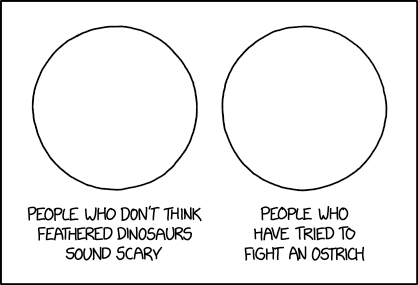
Link to this comic on XKCD
Link to this comic on XKCD
Wednesday, September 12, 2018
New in Version 3.5 of Applied Discrete Structures
The latest version of Applied Discrete Structures (3.5) has a few differences from the previous version. Here is a list of the most significant changes:
In exercises:
Also, there is a new section (12.6) on linear equations mod 2.
Tuesday, July 31, 2018
The Ternary Number System
Every integer is the sum of distinct signed powers of three. That this is true is nice non-elementary, yet accessible, induction proof. It's not an exercise in Applied Discrete Structures, but could be given as a challenge to your students. The code implements the ideas of the proof, so it serves as a hint (or a solution?)
Several years ago, I had a WebMathematica page that computed the ternary representation of an integer. That page is no longer in existence, and I discovered that it several broken links to it were on sequence pages of The On-Line Encyclopedia of Integer Sequences, such as sequence A072998. As a replacement, I created a SageMath interact (similar to a Wolfram Demonstration).
The SageMath interact converts integers from 1 to 1000 to the ternary number system. It is contained within a Sage Cell, so anyone can view and tinker with the code. Any suggestions for improving it are welcome!

Several years ago, I had a WebMathematica page that computed the ternary representation of an integer. That page is no longer in existence, and I discovered that it several broken links to it were on sequence pages of The On-Line Encyclopedia of Integer Sequences, such as sequence A072998. As a replacement, I created a SageMath interact (similar to a Wolfram Demonstration).
The SageMath interact converts integers from 1 to 1000 to the ternary number system. It is contained within a Sage Cell, so anyone can view and tinker with the code. Any suggestions for improving it are welcome!

Subscribe to:
Posts (Atom)